Scott Institute announces 2026 entrepreneurship award winners
Giordana Verrengia
Mar 18, 2026
The Scott Institute for Energy Innovation launched its entrepreneurship award in 2025 to make it easier to translate Carnegie Mellon’s cleantech innovations from research to the market.
“The entrepreneurship award is a unique opportunity to engage not only our faculty affiliates, but also our ambitious student entrepreneurs,” said Daniel Tkacik, executive director of the Scott Institute. “Whether it’s early-stage research, customer discovery, or startups that are interested in expanding their networks, the Scott Institute is proud to support such innovative ideas.”
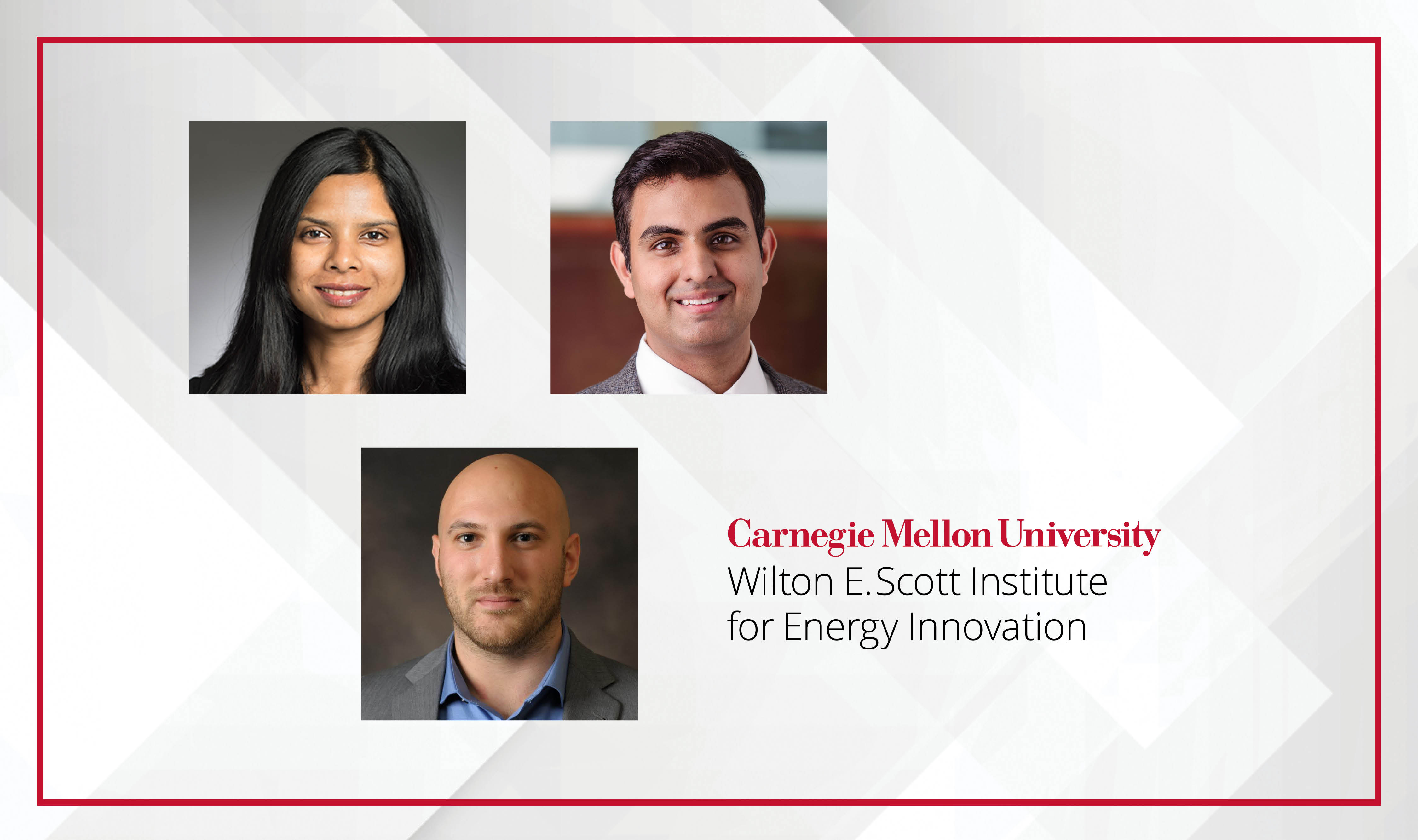
The 2026 award winners were celebrated during CMU Energy Week. The three recipients include both faculty and a graduate student, and come from the College of Engineering, Tepper School of Business, and School of Computer Science.
Reeja Jayan

Awardee Reeja Jayan, a professor of mechanical engineering, will work with PhD student Bashu Aman to support startup Wavon Ceramics during a critical period between laboratory validation and early commercialization.
The entrepreneurship award will allow Aman to work on developing silicon carbide-based composite prototypes, drawing out qualities that allow these composites to potentially be applied to nuclear fusion, a scalable solution for low-carbon baseload energy. Additionally, travel support will allow Wavon’s network to expand at conferences and workshops around the country.
Muhammad Bilal Ayub

Aerial inspection is essential to evaluating the status of energy infrastructure like power lines, but lack of a portable and cost-effective drone option means inspections happen infrequently and are mostly helicopter-based, delaying discovery of leaks and other issues.
Tepper School of Business MBA student Muhammad Bilal Ayub will use the entrepreneurship award to complete a flight-ready prototype of a modular long-range flight system that can conveniently be added to existing drones.
Specifically, Ayub will apply the financial support to purchase flight control electronics, propulsion components, composite airframe materials, and fabrication tools required to validate performance claims related to range, speed, and endurance.
Dimitrios Skarlatos

With an eye on the critical dynamic between AI data centers and energy consumption, Dimitrios Skarlatos will build on previous support from the Scott Institute’s seed grant program.
Skarlatos, an assistant professor in the Computer Science Department, will apply support to engage in broader ecosystem building efforts, such as startup-industry-academia meetups and recruitment events that elevate Carnegie Mellon University, and the Scott Institute, as hubs for deep-tech innovation.