Energy Week 2026 explores future of the power grid
Giordana Verrengia
Mar 31, 2026
Aging infrastructure, extreme weather events, and new energy demands from artificial intelligence (AI) and the electrification of transportation and other industries are shaping the future of the US power grid.
The Scott Institute’s flagship event, CMU Energy Week 2026, convened over 500 energy scholars, investors, entrepreneurs, students, and thought leaders from across the nation to explore the theme of reinventing the grid for our electrified future.
Spanning four days from March 17-20, 2026, the tenth annual conference offered a policy workshop for students, networking and visibility for startups, and a unique exchange of ideas among cross-disciplinary panelists in the energy and sustainability space.
Student Day
Energy Week 2026 started by engaging students in a workshop led by the nonprofit Sustainable Energy and Environment Coalition (SEEC) Institute. The event explored how science, research, and expert ideas become federal policy, culminating in a series of breakout sessions that invited participants to contribute their feedback to the Thriving Economy Project, an in-progress federal policy blueprint that approaches clean energy and economic growth as converging topics. The SEEC Institute expects to release the final report later this year.
The event also featured a panel discussion moderated by Evan Chapman of Tomorrow Energy Partners. Panelists were Eric Fins of Grove Climate Group; Lindsey Baxter-Griffith of Clean Tomorrow; and Paulina Jaramillo, professor of engineering and public policy. Among other themes, panelists discussed how to create more synergy between the fast pace of policy engagement and the often yearslong process of producing research findings.
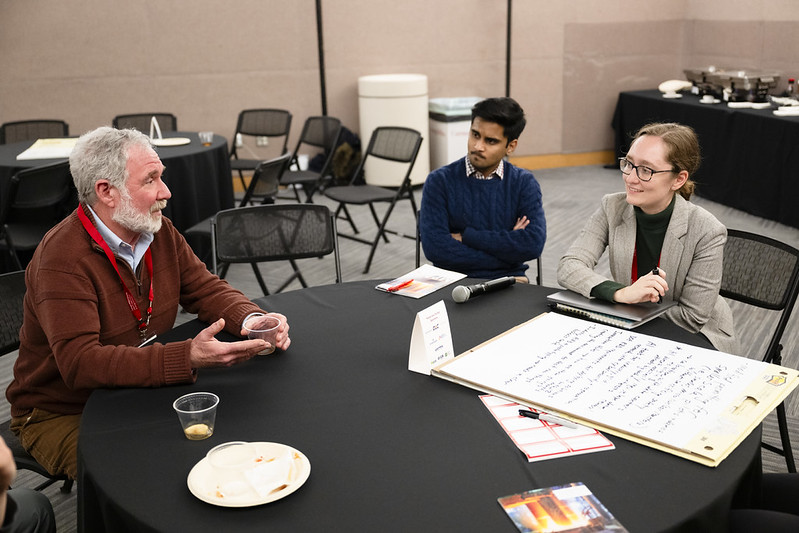
SEEC Institute policy workshop.
Additionally, the popular Student Energy and Sustainability Research Symposium, co-hosted this year with the Steinbrenner Institute for Environmental Education and Research, had an outstanding turnout with roughly 70 poster submissions. Six winners were recognized:
Sustainability winners ($1500 travel awards for each winner):
- Nana Oye Djan, PhD student in engineering and public policy, for the poster “Spatiotemporal dynamics of surface water bodies across sub-Saharan Africa”
- Jessy Ha, PhD student in mechanical engineering, for the poster “Thin proton exchange membranes for water vapor electrolysis”
Energy winners (cash awards provided for each winner):
- First place ($1,000): Adi Mallik, undergraduate student in chemical engineering, for the poster “Charged sorbents as direct air capture technology”
- Second place ($750): Eugene Jeong, PhD student in mechanical engineering, for the poster “Chemical degradation of polymer binder used in hydrogen fuel cell electrodes”
- Third place ($500): Mary Anna Ebbert, PhD student in mechanical engineering, for the poster “Clean, lightweight fuel from the TIDE: Thermally Integrated Deionizer and Electrolyzer for Hydrogen Generation from Seawater”
- Most innovative ($500): Visha Ahmad, graduate student in architecture, for the poster “Infrastructures of the invisible: simulating toxic territories and unequal ecologies of extraction”
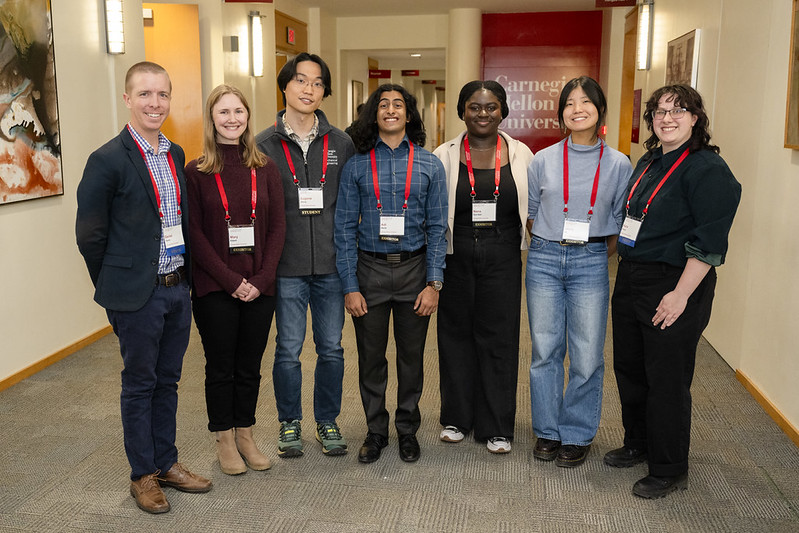

Poster competition winners.
Investor Day
What are the current trends in climate tech investing as observed by the investors and incubators in that space? To support new grid technologies, how can a startup get a deployment in the risk-averse utility industry?
Investor Day contemplated these questions during conversations with expert panelists such as Ramkumar Krishnan, head of cleantech incubation at LG Nova; Elisabeth Iszauk, associate at Montauk Capital; and Guru Nadkarni, retired vice president of strategic planning at Con Edison.
Krishan was also a keynote speaker whose presentation focused on building an energy system for an electrified, AI-driven economy.

Ramkumar Krishnan delivers a keynote.
Noting that factors like AI and electrification have spurred rapid load growth after over a decade of relatively flat demand on the US power grid, Krishnan also underscored the speed at which data centers can fluctuate their energy demand, including power spikes of 10 to 20 megawatts that happen in under one second.
In addition to panel and keynote insights, entrepreneurs stepped into the spotlight during the Energy & Cleantech Startup Pitch Showcase. Twenty startups presented, including several with ties to the Pittsburgh region. The five-minute pitches were followed by immediate feedback from the panel of investor judges, as well as a chance to engage in one-on-one meetings with investors. The startups pitched innovations that ranged from fully-adaptive quantum-accurate materials modeling to reducing plate waste to personalizing home electrification.
Reinventing the grid for our electrified future
“No matter how much bigger the grid will need to be, we know it will need to be bigger. It also will need to be smarter and more efficient,” said Costa Samaras, director of the Scott Institute, during his introductory remarks.
Setting the stage for a series of in-depth and cross-disciplinary keynotes and panel discussions, Samaras drew out the complementary nature of themes like growing grid capacity, increasing grid reliability and resilience, grid security, and energy affordability for supporting a successful build out of the grid over the next 10 years to support electrification.
During her opening keynote, Lou Martinez Sancho, chief technology officer at Westinghouse Electric Company, spoke of growth prospects for nuclear energy to support a secure and sustainable power grid, including the roles of small modular reactors for underdeveloped grids and nuclear microreactors for emissions-free power and stability on local grids.
Martinez Sancho also touched on how technologies like AI and digital twins have supported the company’s nuclear progress in areas like materials innovation and predictive monitoring.

Lou Martinez Sancho delivers a keynote.
Keynote speaker Deborah Gracio, laboratory director of the Pacific Northwest National Laboratory (PNNL), outlined the lab’s multipronged approach to driving grid modernization. Modeling and analytics tools, for example, support better understanding and prediction of grid behavior, while industry partnerships can accelerate the development of new battery and storage technologies.
Also featured was the Energy Week Research Exhibition, highlighting CMU’s innovations in topic areas like microgrids for AI data centers and data-driven methods for safe and resilient grid planning and operations.
Energy & Manufacturing Day
On the final day of Energy Week, Catalyst Connection, an organization that supports regional manufacturing through consulting and training services, led a workshop for opportunities at the intersection of energy, manufacturing, and grid modernization. The Scott Institute and the Resilient Energy Technology and Infrastructure (RETI) Consortium also supported the event.
A technology showcase featured companies including CMU spinouts NovoLINC, which develops chip-cooling technology, and Peoples Energy Analytics, which provides a business solution for identifying and reaching at-risk customers before they default on their energy bills.
Following panel discussions with industry speakers from Emerson Electric, Eos Energy Enterprises, and Westinghouse Electric Company, among others, the program concluded with a keynote address from noted AI and technology analyst, Bob Evans. Evans, the founder of Cloud Wars, spoke to the growing significance of AI across myriad industries, including how it is affecting capital expenditures and shaping manufacturing.

A panel discussion during Energy & Manufacturing Day, led by Catalyst Connection.
During Energy Week 2026, the Scott Institute also announced the 2026 recipients of its seed grants, entrepreneurship awards, and a new award co-sponsored with the Carnegie Bosch Institute to research smart energy technologies.
Energy Week 2026 was supported in part by its generous sponsors, including Anthropic, Duquesne Light Company, Trane Technologies, Emerson Power and Water Solutions, the Resilient Energy Technology & Infrastructure Consortium, Vistra, Eos Energy Enterprises, Exus Renewables North America, and Sargent Electric Company.